Tier 3 — Aurora Sentinel In development — launching soon

The risk picture
leadership deserves.

Sentinel is the change control plane of the Aurora Platform. It ingests signals from across your test coverage, pipeline health, and repository activity to produce a clear, evidence-based risk picture for every change — before it reaches production.

Not a report someone wrote. Not a traffic light someone set. Evidence.
Kubernetes Linux macOS Windows (WSL2) GitHub integration
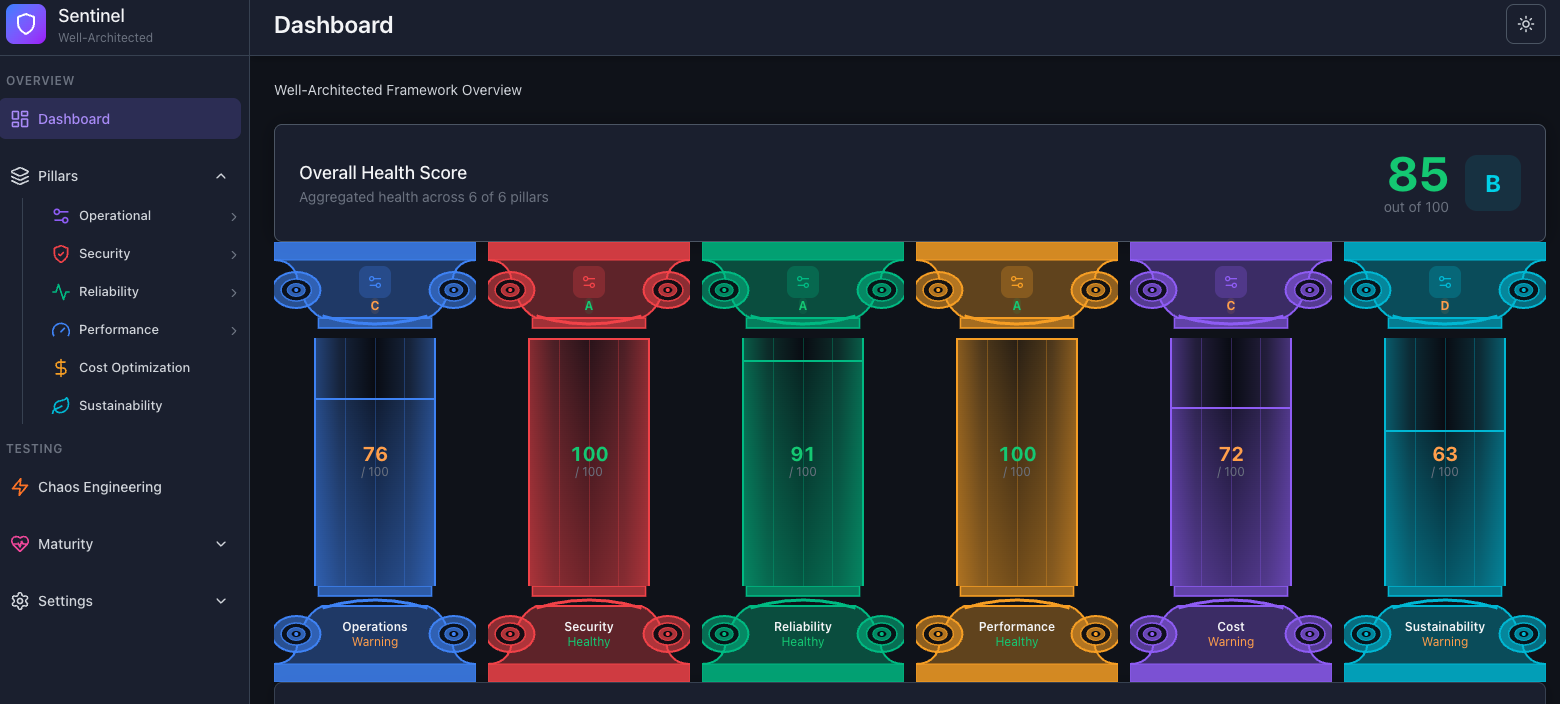
Aurora Sentinel Six Pillars Dashboard

Release risk decisions made without independent visibility.

In most engineering organisations, the question "is it safe to ship?" is answered by engineers, under delivery pressure, using incomplete information. Senior management either rubber-stamps the decision or panics — because they have no independent view of what the risk actually is.

Sentinel changes the structure of that conversation — by giving leadership an evidence base they didn't have before.

Manual release readiness reports assembled by a senior engineer the day before go-live
Traffic light dashboards that someone set manually and nobody trusts
CAB meetings where leadership asks questions the engineering team can't answer without another 24 hours of digging
CTOs making release calls on gut feel because the actual data is locked inside Jira and test logs

Built for the whole organisation

Sentinel delivers value across the business. See what it means for your role.

Reduced release risk Clear production readiness signals mean fewer surprises in production. Know exactly what's shipping and what risks remain before every release.
Executive visibility Six Pillars dashboards give leadership a single view of production readiness across all teams. No more chasing engineers for status updates.
Audit-ready governance Every pillar assessment is logged with timestamps and evidence. Generate compliance reports that prove due diligence for auditors and regulators.
Cost visibility The Cost pillar tracks infrastructure spend per deployment. Catch cost regressions before they hit the bill — not after.
Sustainability reporting Track carbon footprint and energy efficiency metrics. Demonstrate ESG commitment with real data from your engineering practices.
Full data ownership All assessments, signals, and reports stay on your infrastructure. No third-party data processors — no subprocessor agreements to manage.

Production Readiness Signals

Clear, unambiguous signals that tell your team whether a release is ready to ship.

CLEAR
No issues found. Ship with confidence.
APPROVED
Reviewed and accepted by approvers.
CONDITIONAL
Minor issues to address before release.
HOLD
Blocking issues. Do not release.
PENDING
Analysis in progress. Stand by.

The Six Pillars

Every change is evaluated against six dimensions of production readiness. Each pillar has configurable policies, automated checks, and clear reporting.

Security Vulnerability scanning with Nuclei. Detects OWASP Top 10, CVEs, and misconfigurations. Blocks releases with critical findings.
Performance Load testing with k6. Baseline response times, throughput, and error rates. Detect regressions before they reach users.
Reliability Chaos engineering with Chaos Toolkit. Uptime monitoring with Blackbox Exporter. Know how your system behaves under failure.
Operations Deployment health, resource utilisation, and observability coverage. Ensure changes are operable in production.
Cost Resource utilisation, idle resource detection, and cost-per-request tracking. Deliver business value at optimal cost.
Sustainability Carbon footprint scoring, energy efficiency metrics, and green region usage. Reduce environmental impact through efficiency.

GitHub-First Workflow

Sentinel connects directly to your GitHub repositories. No separate dashboards to check — signals appear where your team already works.

PR Status Checks
Readiness signals appear as GitHub status checks. Block merges when pillars fail.
PR Comments
AI-generated risk narratives posted directly to pull requests.
Webhook Events
Automatic analysis on push, PR open, and release creation.
Release Tracking
Historical view of readiness signals across all releases.

AI-Powered Risk Narratives

Raw scan outputs become actionable insights. Sentinel uses AI to explain what changed, why it matters, and what to do next.

Contextual summaries Instead of "CVE-2024-1234 found", get "This change introduces a SQL injection vulnerability in the user search endpoint that could expose customer data."
Risk scoring Each finding is scored based on exploitability, blast radius, and business context. Focus on what matters most.
Remediation guidance Specific, actionable steps to fix each issue. Code snippets, configuration changes, and links to documentation.

Continuum Integration

Functional tests tell you if the code works. Sentinel tells you if it's ready for production. Together, they give you the complete quality picture.

Aurora Continuum
Functional test results aggregated from any framework.
+
 
Aurora Sentinel
Production readiness signals from five pillars.

Both products push data to a unified dashboard. See functional correctness and non-functional readiness side by side.


The people accountable for release risk — not just the people running the tests.

Sentinel is the first product in the Aurora Platform built specifically for the people above engineering.

CTO

Clear risk view before every release. No Jira, no test logs — just the signal.

Delivery director

Quality outcomes mapped to the programmes you're accountable for delivering.

Head of engineering

The bridge between engineering reality and leadership expectation — made visible.

Programme manager

Know which initiatives are at quality risk before they become delivery risk.


What Sentinel ingests

  • Test pack coverage and pass/fail trends from Continuum
  • Repository change signals and commit activity
  • Business initiative and programme mapping from Continuum
  • DORA metrics history — deployment frequency, change failure rate, MTTR
  • Aurora test pack coverage gaps and locator healing activity

“The hardest question in software delivery isn't 'is it done?' It's 'is it safe to ship?' Sentinel is the first product built to answer that question for the people who have to make the call.”

— Martin Croft, Founder, Selectred

In development — launching soon

Get early access to Sentinel

Sentinel is in active development. Early access partners get priority onboarding, direct input into the roadmap, and preferred commercial terms.

Or email directly: support@selectred.com


Sentinel is Tier 3 of the Aurora Platform. Aurora (Tier 1) and Continuum (Tier 2) are in production and available for demo now.    Aurora →  ·  Continuum →  ·  Platform overview →


Common questions

Everything you need to know about Aurora Sentinel.

Sentinel is a production readiness control plane that monitors your codebase for changes affecting non-functional requirements. It integrates with GitHub to track commits, PRs, and releases, then evaluates them against six pillars: Security, Performance, Reliability, Operations, Cost, and Sustainability.
Sentinel issues clear release signals: CLEAR (no issues), APPROVED (reviewed and accepted), CONDITIONAL (minor issues to address), HOLD (blocking issues found), and PENDING (awaiting analysis). These signals give teams confidence to ship.
Each pillar (Security, Performance, Reliability, Operations, Cost, Sustainability) has configurable policies and thresholds. When code changes touch areas relevant to a pillar, Sentinel runs the appropriate analysis — vulnerability scans, load tests, chaos experiments, or cost assessments.
Sentinel connects via GitHub webhooks. It monitors commits, pull requests, and releases. When changes are detected, it triggers relevant pillar analyses and posts results back to PR comments and status checks.
Sentinel uses AI to generate human-readable risk narratives. Instead of raw scan outputs, you get contextualised explanations: what changed, why it matters, what the risk level is, and what to do about it.
Yes. Sentinel pushes production readiness signals to Continuum, where they appear alongside functional test results. Teams see the complete quality picture — functional correctness plus non-functional readiness.
Never. Sentinel runs entirely inside your Kubernetes cluster. No telemetry, no cloud sync, no third-party data processors.

Get help

Reach out via email and we'll get back to you.

Email Support

Deployment, configuration, and licensing questions.

support@selectred.com

Guides & Docs